
Descending Safely and Smoothly (Even If You’re Nervous)
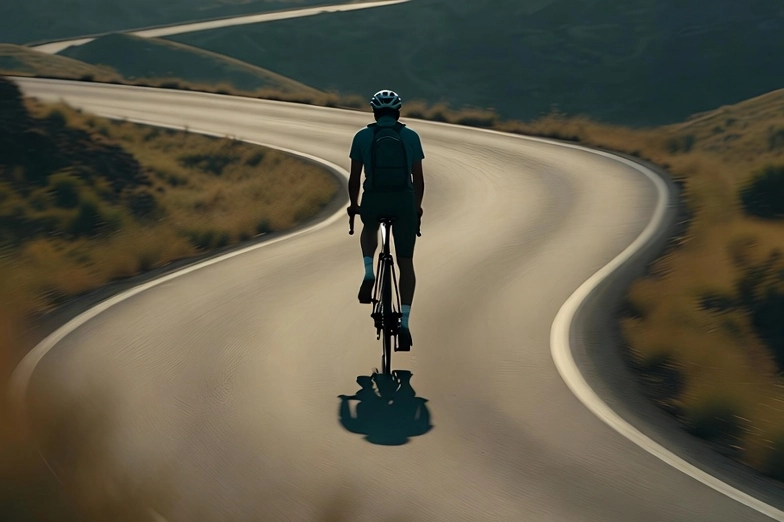
Descending safely should feel like a reward — the payoff after all the climbing. But for many riders, it’s the part of cycling that triggers tight shoulders, white‑knuckle braking, and a quiet hope that the road flattens out soon.
If that sounds familiar, you’re not alone. Confidence when descending safely isn’t something you’re born with; it’s a skill you build. However, the good news is that with a few simple techniques, you can go from tense and hesitant to smooth, controlled, and genuinely enjoying the ride.
Below is a step‑by‑step guide to help you descend safely, calmly, and eventually with far more confidence.
🚴♂️ 1. Start With a Relaxed Body Position
Tension is the enemy of control. When you’re stiff, the bike becomes twitchy and every bump feels amplified.
What to do instead
- Keep your elbows slightly bent — they act as natural suspension.
- Loosen your grip on the bars; think “firm but gentle,” not “death grip.”
- Drop your shoulders away from your ears.
- Breathe out as you begin the descent — it resets your posture.
A relaxed rider is a stable rider.
👀 2. Look Where You Want to Go
Your bike follows your eyes. If you stare at the pothole, you’ll hit it. If you stare at the bend’s exit, you’ll glide through it.
Make this your habit
- Look far ahead, not at your front wheel.
- Scan the road: surface, camber, traffic, gravel, drain covers.
- In corners, turn your head and look through the bend.
This single habit transforms descending more than almost anything else.
🧱 3. Brake Early, Not Late
Braking in a corner is where riders get into trouble. Braking before a corner is where riders stay safe.
Use this simple rule
- Slow in, smooth out.
- Do your braking before the turn.
- Release the brakes as you lean the bike.
- Feather the brakes lightly if you need to adjust speed.
Modern brakes are powerful — use them with intention, not panic.
🪶 4. Lower Your Centre of Gravity
A lower centre of gravity gives you more stability and control.
Try this
- Slide your weight slightly back on the saddle.
- Lower your torso a little.
- Keep your pedals level when coasting.
- Drop your heels slightly — it anchors you to the bike.
You’ll instantly feel more planted.
🧭 5. Let the Bike Lean — Not Your Body
Many nervous riders try to keep the bike upright and lean their body instead. This feels safer but actually reduces grip.
The safer technique
- Keep your body more upright.
- Let the bike lean underneath you.
- Press slightly on the outside pedal for stability.
This gives your tyres maximum contact with the road.
🧩 6. Build Confidence Gradually
You don’t need to tackle Alpine switchbacks to improve – start small.
Practice on
- Short, gentle descents
- Quiet roads
- Repeated laps of the same hill
- Smooth, predictable corners
Repetition builds muscle memory — and muscle memory builds confidence.
🧠 7. Manage the Mental Side
Fear is normal. The trick is not eliminating it, but managing it.
Try these mental cues
- “Light hands, heavy feet.”
- “Look ahead.”
- “Smooth, not fast.”
- “Breathe.”
Descending is a skill, not a test of bravery.
🛠️ 8. Check Your Equipment
Confidence comes easier when you trust your bike.
Before descending, make sure
- Tyres are properly inflated
- Brake pads aren’t worn
- Wheels spin true
- Nothing rattles or feels loose
A well‑maintained bike is a safer bike.
🌄 9. Speed Comes Later — Smooth Comes First
Fast descending is a by‑product of smooth descending. Don’t chase speed, chase technique and eventually speed will follow naturally, and safely.
Final Thoughts
If descending makes you nervous, you’re not “a bad cyclist” — you’re a normal one. Every confident descender you’ve ever seen once felt exactly the same way.
Start small, stay relaxed, look ahead, brake early and let the bike do its job.
With practice, descending safely becomes one of the most joyful parts of cycling — a moment of flow where everything feels effortless.
And when that moment arrives, you’ll wonder why you ever worried at all.
For more great tips and advice check out our Index Page