
Cycling Helmets – Getting the Right Fit
Cycling helmets are a great cause for debate. This post isn’t going to be a good vs bad review; there’s plenty of discussion in other places online for that. What we will attempt to explain here is the right way to wear a helmet, should you choose to do so.
Wearing a cycling helmet correctly is one of the simplest and most effective ways to reduce the risk of serious head injury, but many riders still wear them too loosely, too far back, or in the wrong size.
Why helmet fit matters
A helmet only works when it stays in place during an impact. A poorly fitted helmet can rotate, slip off, or fail to absorb force where it’s needed most. Similarly, even small mistakes—like leaving the straps loose—can dramatically reduce protection.
The correct way to wear a cycling helmet
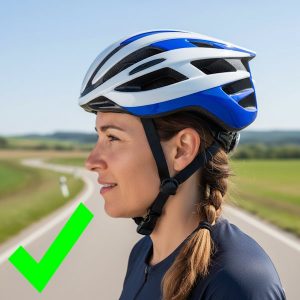
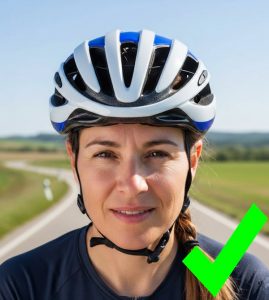
A good fit follows the “Eyes–Ears–Mouth” rule:
👁️ Position over the eyes
Cycling helmets should sit level on the head, not tilted back.
- The front edge should rest 1–2 finger widths above your eyebrows.
- You should be able to look up and just see the brim.
👂 Straps around the ears
The side straps should form a “V” shape that meets just below your earlobe.
- Adjust the sliders so the V is neat and symmetrical.
- Straps should lie flat against your head, not twisted.
👄 Buckle under the chin
The chin strap should be snug but comfortable.
- Aim for one finger of space between the strap and your chin.
- When you open your mouth wide, the helmet should press down slightly—this means it’s secure.
Quick fit check
- Shake your head side to side: the helmet should move with you, not slide.
- Push up from the front: it shouldn’t roll back.
- Push from the back: it shouldn’t tip forward.
How to get the right size
Helmet sizing varies by brand, but most follow head circumference in centimetres.
🧵 Step 1: Measure your head
Use a soft tape measure:
- Wrap it around your head, just above the eyebrows and ears.
- Keep it level all the way around.
- Note the measurement in cm.
📏 Step 2: Match the size range
Typical adult sizes:
- Small: 51–55 cm
- Medium: 55–59 cm
- Large: 59–63 cm
Choose the size where your measurement sits comfortably in the middle of the range.
⚙️ Step 3: Fine‑tune the fit
Most modern cycling helmets include:
- Dial adjusters at the back
- Internal cradle systems
- Interchangeable padding
Adjust these until the helmet feels snug all around without pressure points.
🧪 Step 4: Try it with your riding gear
If you wear a cap, headband, or winter skullcap, test the fit with those too. A helmet that fits perfectly in summer may conversely feel tight in winter layers.
Common mistakes when wearing a cycling helmet
These errors are extremely common—and easy to fix.
- Helmet tilted back — exposes the forehead, the area most likely to hit the ground.
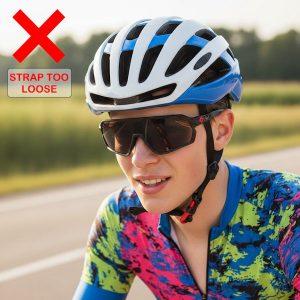
- Straps too loose — allows the helmet to shift or come off in a crash.
- Wearing a hat or hood underneath — compromises fit and stability unless the fit has been done with this in mind.
- Incorrect size — too big = unstable; too small = uncomfortable and unsafe.
- Not replacing after a crash — even minor impacts can damage the internal foam which in turn affects the helmets performace in subsequent crashes.
- Using a worn‑out helmet — UV exposure and age degrade materials; for this reason most brands recommend replacing every 5–7 years.


The consequences of wearing a helmet incorrectly
A poorly fitted helmet can be almost as ineffective as not wearing one at all.
🚫 Reduced impact protection
If the helmet shifts during a crash, the force may bypass the protective foam entirely.
🚫 Increased risk of facial injuries
A helmet worn too far back leaves the forehead exposed, consequently leading to cuts, fractures, and dental injuries in the event of an accident.
🚫 Rotational injuries
Loose straps allow the helmet to twist, as a result rotational forces on the brain increase—one of the main causes of concussion.
🚫 Helmet loss during impact
If the buckle is loose or the helmet is oversized, it can come off completely, thus leaving the rider unprotected at the worst moment.
Final thoughts
A cycling helmet is one of the most important pieces of kit you own. Getting the fit right takes less than a minute, but the benefits last every ride. Whether commuting, training, or hitting the trails—wearing your helmet correctly is a simple habit that dramatically improves safety.
For more great cycling advice visit our Index Page